
When you plug in an electronic device, you probably don’t think much about the small block converting power from your wall outlet. But that humble power supply is critical and choosing the wrong one can be disastrous. While many look similar, the voltage they deliver makes a world of difference. Two common voltages you’ll encounter are 9V and 12V.
They might seem close enough, but they are not interchangeable. Using a 12V supply on a device designed for 9V can permanently damage it, while using a 9V supply on a 12V device will likely result in poor performance or failure to turn on. This article compares 9V and 12V power supplies, explains their distinct applications and highlights the risks of mixing them up.
Understanding 9V and 12V Power Supplies
Before diving into the differences, let’s look at what each voltage is typically used for. The choice of voltage often comes down to a balance between power requirements and portability.
What is a 9V Power Supply?
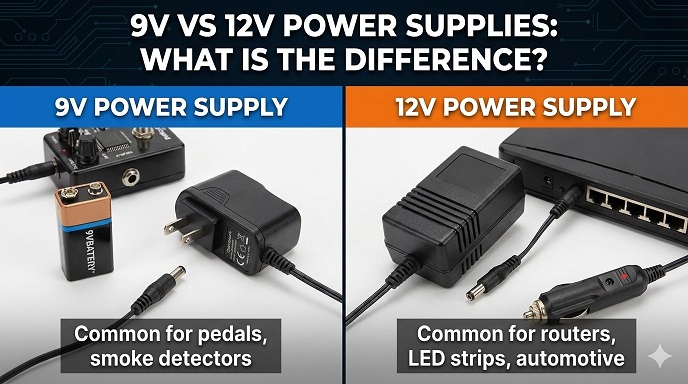
A 9V power supply is most famously associated with the rectangular 9V battery used in smoke detectors and guitar pedals. This voltage became standard for small, portable electronics that needed more power than smaller AA or AAA batteries could efficiently provide.
In AC adapters, a 9V supply is common for devices that require a bit more electrical “push” than the 5V standard of USB but don’t need the higher power of 12V systems. You will often find them powering stationary musical equipment, specific types of routers and various electronic toys.
What is a 12V Power Supply?
The 12V standard is one of the most versatile and widely used low-voltage DC power sources. Its origins are in the automotive industry, where car batteries have long operated at 12V. This adoption led to a massive ecosystem of 12V components, from lights and fans to chargers and audio equipment.
Because it can deliver more power efficiently than 9V, 12V is the go-to for devices that work a little harder. This includes LED lighting strips, CCTV security cameras, computer components and small pumps. It provides a great balance of power, safety and efficiency for a huge range of consumer and commercial electronics.
Why 9V and 12V Are Not Interchangeable
The most important takeaway is that you cannot simply swap a 9V and a 12V power supply. The reason lies in how electronic components are designed. Each component, from a simple resistor to a complex microprocessor, is rated to operate within a specific voltage range.
Think of voltage as water pressure. If you connect a garden sprinkler designed for low household pressure to a high-pressure fire hydrant, the sprinkler head will break. The same principle applies to electronics.
- Risk of Overvoltage: Plugging a 12V power supply into a device designed for 9V sends 33% more voltage than its components are built to handle. This excess electrical pressure can overheat and “fry” sensitive parts like integrated circuits, capacitors and regulators. The damage is often instant and irreversible.
- Risk of Undervoltage: Plugging a 9V power supply into a 12V device is less likely to cause permanent damage, but the device won’t work correctly. It will be starved for power, leading to malfunctions like flickering lights, motors failing to spin up or electronics that simply won’t turn on.
Always check the label on your device for its power requirements before plugging in any adapter. Manufacturers print this information near the power input jack for this very reason.
Applications of 9V and 12V Power Supplies
The specific voltage a manufacturer chooses is based on the device’s power needs, portability and component availability.
Common Applications for 9V
The 9V standard is perfect for devices that are often portable or have moderate power needs.
- Guitar Effects Pedals: The 9V battery is an icon in the music world and most pedals can also be powered by a 9V DC adapter.
- Smoke Detectors and Carbon Monoxide Alarms: These use 9V batteries as their primary or backup power source.
- Portable Radios and Walkie-Talkies: Many handheld communication devices rely on 9V for power.
- Electronic Toys and DIY Projects: Arduino starter kits and other hobbyist electronics frequently use 9V as an external power source.
Common Applications for 12V
The 12V standard is dominant in applications requiring more consistent and higher power.
- LED Strip Lighting: Most long or bright LED strips run on 12V to efficiently power dozens or hundreds of individual diodes.
- CCTV and Security Systems: Cameras, DVRs and other surveillance equipment almost universally run on 12V.
- Automotive Accessories: Anything you plug into a car’s cigarette lighter socket runs on 12V, including phone chargers, dash cams and tire inflators.
- Computer Components: PC case fans, hard drives and cooling systems often use a 12V rail from the computer’s main power supply.
- Networking Gear: Many consumer-grade routers, modems and network switches use 12V adapters.
Comparison Table: 9V vs 12V at a Glance
This table summarizes the key characteristics and use cases for each voltage.
| Feature | 9V Power Supply | 12V Power Supply |
| Primary Use | Portable electronics, musical equipment, smoke alarms | Automotive, LED lighting, CCTV, computer components |
| Common Devices | Guitar pedals, Arduino boards, portable radios | Routers, security cameras, LED strips, external hard drives |
| Power Capacity | Lower; suitable for moderate power needs | Higher; suitable for more demanding devices |
| Risk of Misuse | Supplying 9V to a 12V device causes malfunction | Supplying 12V to a 9V device can cause permanent damage |
| Portability Factor | Often associated with the portable 9V battery form | Standard for vehicle systems and stationary electronics |
Tips for Choosing the Right Power Supply
Making the right choice is simple if you follow a few basic rules.
- Read the Device Label: Your electronic device is the ultimate source of truth. Look for a label or embossed text near the power input. It will specify the required voltage (V) and current (A or mA). The voltage must match exactly.
- Match the Polarity: Besides voltage, adapters have a “polarity,” indicated by a small diagram with a plus and minus sign. Most devices use “centre-positive” polarity, but musical equipment sometimes uses “centre-negative.” Mismatching this can also damage your device.
- Ensure Enough Current: The amperage (A) rating on the power supply must be equal to or greater than the device’s requirement. A device requiring 1A will work fine with a 2A supply, but not with a 0.5A supply.
- Buy from Reputable Sources: When replacing a lost or broken adapter, purchase from a trusted electronics supplier like Campad Electronics. Cheap, uncertified adapters from online marketplaces can be a fire hazard and may not provide stable voltage, risking your equipment even if the ratings seem correct.
Conclusion
While 9V and 12V power supplies may look alike, they serve very different purposes and are not interchangeable. The 3-volt difference is enough to render a device inoperable or destroy it completely. 9V is the hero of many portable and mid-power devices, while 12V is the workhorse for more demanding electronics in our homes, cars and offices.
The next time you reach for a power adapter, take a moment to double-check the voltage, current and polarity. Matching these simple specifications is the key to ensuring your electronics operate safely and reliably for years to come.
Frequently Asked Questions about 9V and 12V Power Supplies
Can I use a 12V power supply on a 9V device?
No, you should never do this. Using a 12V supply on a device built for 9V delivers too much voltage (“electrical pressure”). This will likely overheat the internal components and can permanently destroy your device. Always match the voltage exactly.
Can I use a 9V power supply on a 12V device?
This is also not recommended. While it is less likely to “fry” the device than the reverse situation, a 12V device will not receive enough power to operate correctly. It may fail to turn on, behave erratically, or the power supply itself could overheat from struggling to meet the demand.
How do I know if I need a 9V or 12V power supply?
Check the label on your device. Most electronics have a small sticker or embossed text near the power input jack that states the required voltage (e.g., “Input: 9V DC”). If the device doesn’t have a label, check the user manual or look up the model number online.
What happens if the Amperage (A) on my new power supply is higher than the old one?
That is perfectly safe! A power supply with a higher amperage rating (e.g., using a 2A supply for a device that needs 1A) is fine. The device will only draw the current it needs. However, never use a supply with a lower amperage rating than required.
What is polarity, and why does it matter?
Polarity refers to which part of the connector is positive (+) and which is negative (-). Most modern consumer electronics use “Center Positive” polarity. However, some music equipment (like guitar pedals) uses “Center Negative.” If you plug a center-positive adapter into a center-negative device, you can damage the circuit immediately. Look for the polarity symbol on your device before plugging in.
Can I use a laptop charger for my 12V devices?
Usually, no. Most laptop chargers operate at higher voltages, typically between 19V and 20V. Plugging a 19V laptop charger into a 12V device will almost certainly destroy it. Always check the output voltage printed on the “brick” of the charger.
My power supply is getting hot. Is that normal?
It is normal for power supplies to get warm during use, especially if they are powering a device that draws a lot of current. However, if it becomes too hot to touch or starts smelling like burning plastic, unplug it immediately. This indicates the supply is overloaded or failing.
Where is the best place to buy a replacement power supply?
Avoid cheap, unbranded generic adapters found in bargain bins, as they often lack safety features. We recommend purchasing high-quality, certified power supplies from reputable electronics retailers like Campad Electronics to ensure safety and reliability.